



The Learning Lens is a series within Between Here and Benin, published every other Thursday, that explores the research behind Hello West Africa.
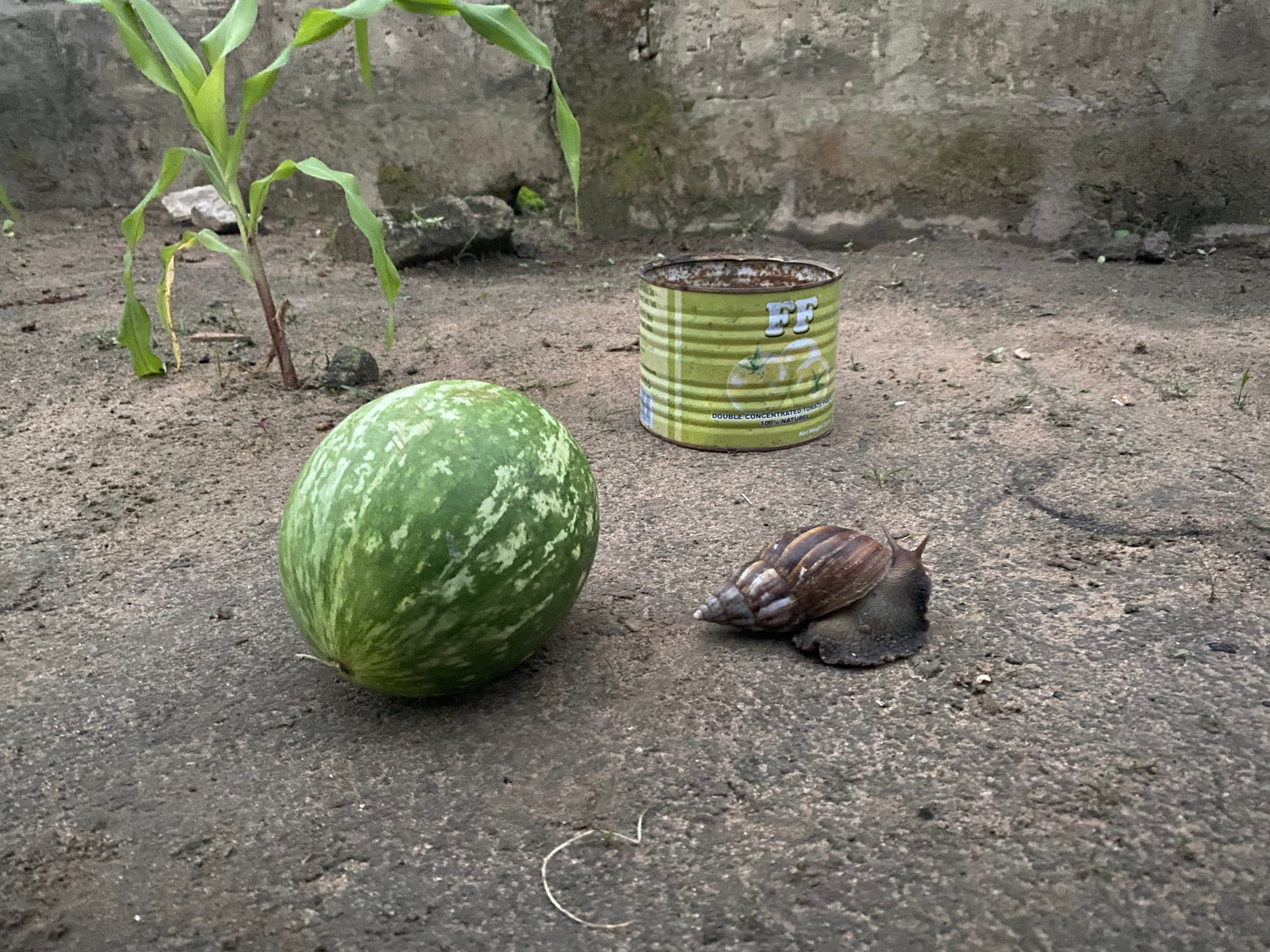
I recently spent an hour outside watching snails with my two-year-old.
Why? I’m fascinated by snails, to be completely honest. And also, I needed to think. I had this issue to write, and I needed my mind to start moving toward how I was going to talk to you about transformative tourism and how you can actually make it happen.
Snails in Benin, by the way, are enormous compared to the ones we have here in Washington. I will leave a picture below so you can see what I mean.
So what do snails have to do with transformative tourism?
Nothing, really. But that hour of quiet, slow watching gave me something I fully expected…clarity. I’ll come back to that at the end of this issue…
The Question I Set Out to Answer
I have spent the last several issues of The Learning Lens talking about what transformative learning theory is, what the 10 Phases mean, and why transformation happens after the experience ends rather than during it.
Today I want to get practical.
My doctoral research set out to answer one question: What factors or processes make transformational learning possible for a tourist in a five-week online tour?
To find out, I built a five-week online tour of Benin, West Africa, and studied what actually happened to participants as they moved through it, using Jack Mezirow’s 10 Phases of Meaning as my guide. I had six participants, and my findings boiled down to five things.
(I have included quotes from my research participants within my findings; all names have been changed to protect their privacy.)
1. Human connection is the foundation.
At the core of this research, I found that transformative learning is all about human connection, regardless of whether the experience is online or in-person. In a world that is increasingly enthralled with AI, human-centered experiences are becoming a luxury. A luxury that is critical for transformation to occur. The development of trust between you and your traveler. Showing them that you are vulnerable, able to listen, curious, willing to adapt and learn based on what they are telling you.
2. Design shapes everything.
The way an experience is structured, the storytelling, the pacing, the flexibility, the sensory details, all of it either opens people up or closes them down. Transformation doesn’t happen to passive observers. It happens to people who feel invited in.
People also come as they are. Their prior experiences, assumptions, and motivations all shape how they engage with what you put in front of them. As the person designing the experience, you need to be aware of that. You cannot assume everyone is starting from the same place, because they never are. Use your own experiences to shape a venture that you yourself would like to go on.
That is how I designed the online tour. I drew upon my background of online learning and design (over 50 online courses certainly provide quite a bit of context), and along with the research I had done on transformative learning theory, designed a “tour” (basically just an online course) that I would want to take.
One of the most important design choices I made was building in flexibility. The tour was structured enough to feel intentional, but open enough to follow the participants’ curiosity. When Ann asked whether Vodun served as a unifier among Benin’s many ethnic groups, I was able to dive deeper into that topic in the next session. When Kate expressed discomfort about how I had initially described Vodun, I acknowledged the misrepresentation and corrected it. When Shaun noted that sound would make the videos more immersive, I fixed the technical setup. When Paula asked for a map to better understand the village's geographic location, I added one.
Listening to your guests and adapting in real time are not signs of a poorly designed tour. It is the design working exactly as it should.
3. Reflection is the engine.
An experience without a structured space for reflection is just an event. Reflection is what turns an encounter with something unfamiliar into a genuine shift in perspective. It is the mechanism through which people process everything they have seen and felt, and it is where change actually begins to take shape. You can see this in Ann’s comment, “…I realized how many assumptions I had because of the reflection questions.”
And here is something important: change is gradual, not dramatic. Transformative learning has 10 phases. You are not going to move through all of them in a single afternoon. It builds over time, which means the experience you design needs to sustain conditions for change, not just create one memorable peak.
4. Transformation requires integration support, especially after people go home.
The later phases of transformation, Phases 8, 9, and 10, where a shift in perspective gets integrated into daily life, happen after travelers return home.
Most operators have no contact with their travelers at that point. The support disappears exactly when it is needed most. Participants have a remarkable time, go home, and slowly return to exactly who they were before. The tour ends. And that is where it stops.
I have experienced this multiple times. When I finished my doctorate, I received my diploma, and then the support disappeared almost immediately, exactly when I needed it the most. Peace Corps felt less abrupt because we had a close-knit community we could still reach out to. But that human connection after the experience is the bridge to make transformative learning fall into place. If you can keep supporting people through their return home, the incredible shifts in perspective that are possible are incredible.
Six People. Six Different Transformations.
As mentioned in the beginning, I had six participants in my 5-week online tour of Benin. Each of them had a transformative learning experience. And every single one was different.
One participant looked at her immigrants in her community with new eyes. She realized that the Honduran immigrants at her church had lives similar to the people she had been learning about in Benin. She reflected: they chose to be here. I really need to respect that. That was a transformative learning experience I certainly didn’t expect from a five-week online tour.
One participant said they hadn’t realized how incredible Africa was until it was over, and now wanted to travel to Benin in person.
One participant became more willing to be vulnerable with language while traveling, even without fluency, because they had seen firsthand what a difference it made to simply try to speak the local language.
One participant was amazed that an online tour could feel like an in-person experience rather than a cold Zoom call.
One participant recognized how many assumptions they had been carrying about other people’s daily lives and named that recognition significant.
And one participant, who had previously spent time in another African country, came away with a new understanding of just how different African countries are from one another. She combined her prior experience with what she had learned about Benin and saw the continent differently as a result.
Six people. Six different transformative learning experiences.
This isn’t an accident, this is the whole point.
Transformative learning theory did not originate in tourism. It came from education, and one of the great struggles in education is that we all learn differently and arrive at different outcomes. We are slowly recognizing that designing for a single, prescribed transformation is not very effective. The same is true in transformative tourism. You cannot expect everyone to have the same experience. And you should not try to engineer one.
If you keep the design broad, create the conditions, and then get out of the way, people will have the experiences they are meant to have. What an interesting concept, eh?
A little example…How we are designing Hello West Africa to work through the 10 Phases
So how do we actually make these things happen?
It starts before travelers ever arrive in Benin.
The first step is a conversation, an interview of sorts, where I get to know the traveler. I ask about their motivations, their past experiences, and their expectations. This is not just data gathering. It is the beginning of a relationship built on human connection and trust. During a recent group call arranged by Rebecca Maffeis, someone noted that this kind of personal touch has almost become a luxury in travel, that people now see speaking to an actual human as a marker of a high-end experience.
After that initial conversation, travelers will move through the online tour of Benin that I built for my research. It will be a shorter version, but it will serve to pique curiosity, give people a sense of what to expect, and begin building a community with the other travelers they will be experiencing Benin alongside.
Then comes the in-person tour.
During our time in Benin, we will have dedicated reflection periods in the evening. I am thinking about setting up a kind of video confessional, a quiet space where people can sit and talk through their thoughts if they want to. I will also ask questions during meals and while we are driving, keeping the conversation alive and making people feel comfortable working through what they are experiencing.
The tour schedule will not be completely booked. If you look at the sample itinerary on our website, you will see intentional open space. This is not an accident. As curiosity builds, people may want to visit a mosque, or ask what women do at three in the afternoon, or follow a thread that nobody could have predicted. We want to leave room for that.
We will also engage in what I call Knowledge Exchanges. These begin before travelers arrive. I will learn something about each traveler’s life and work, and then create an encounter with a local community member who does something similar. A teacher meeting a local teacher. A baker sharing their sourdough knowledge with a local boulangerie. The goal is not to compare who does it better. It is simply to see how the same thing can be done differently, and to learn from that.
After the tour ends, the online community stays open. Travelers return home, but the support does not disappear. That channel for dialogue remains available for at least a year, included with the tour. This is the part I was unable to fully explore in my research, and I am so curious to see what happens.
Back to the Snails
That hour I spent outside with my two-year-old, watching snails move slowly across the ground, was not productive in any conventional sense. I did not check anything off a list. I did not answer emails.
But I came back inside knowing what I wanted to say to you today.
That is reflection, the kind that most of us do not give ourselves permission to have.
A few things worth holding onto from today:
Human connection is the glue. Without it, none of the rest works.
Design shapes everything…the storytelling, the pacing, the flexibility, the space for curiosity.
Reflection is the engine. Not as an afterthought, but as an intentional part of the design.
And change is gradual. Design for the process, not just the peak moment.
As important as it is for your guests to reflect, so it is for you as well, as the creator, educator, and backbone of the tour, to find that reflection space.
So go watch the snails sometimes. You might be surprised by what you figure out or by the questions that arise.
Curious about how to bring transformative learning into your own tours or experiences? Hit reply. I would love to hear what you are working on.
Until next time,

P.S. — Hello West Africa is looking for aligned investors and Founding Supporters. If you want to be part of building this before the doors open, reply to this email and let’s talk.
The Ten Phases of Transformative Learning
Jack Mezirow, for reference
Disorienting dilemma — an experience that causes confusion or discomfort, leading you to question your assumptions.
Self-examination — reflecting on feelings of anxiety or guilt as a result of the dilemma.
Critical assessment of assumptions — realizing that some of your beliefs or assumptions might be flawed or limiting.
Recognition of shared experience or discontent — understanding that others have faced similar challenges or questioned the same assumptions.
Exploration of new roles, relationships, and actions — considering new perspectives, behaviors, or ways of thinking.
Planning for change — developing a course of action.
Acquiring knowledge and skills — learning what is needed to implement the new plan or perspective.
Testing new roles — trying out new behaviors or ways of thinking in real-life situations.
Building competence and self-confidence — gaining confidence as new behaviors or thoughts become more familiar.
Reintegration — adapting the new perspective into your life, making it part of how you think or act regularly.


