



The Learning Lens is a series within Between Here and Benin, published every other Thursday. It's where I think out loud about transformative learning theory — what it is, why it matters, and how it shapes everything I'm building with Hello West Africa. No PhD required. Just curiosity.
This week, I came across a post from a travel professional I follow on LinkedIn. He was pushing back on the word “transformative” in travel, and I appreciated the perspective.
His argument went something like this: most people don’t want a trip that changes their life. They want a break. Time with their family. Something different. And the change that does happen is subtle; it comes from seeing the world from a new angle, from demystifying what felt strange, from realizing there is more that unites us than divides us across the globe.
He described a family he had taken on a two-month trip through Ecuador, the Galápagos, and Colombia. Volcanoes, the Amazon, and some of the most spectacular places on the planet. They came home with inside jokes, stories to recount, two months of family time, and horizons that had forever shifted.
A trip of a lifetime, he said. But transformational? Life-changing? That’s a bit hyperbolic. Their kids went back to school. They went back to work.
He ended with this: “I can’t change lives, but I can certainly enrich them.”
I read it twice. And I thought, he’s right about how subtle the shift can be. But I think he stopped one step short.
How I Got Here
I want to talk a little about how I discovered transformative learning theory and why I started looking into it in the first place.
I wanted to provide people with an experience similar to what I had during my Peace Corps service, where I returned home with a changed perspective. I knew something had shifted in me. I just didn’t have the language for it yet. I had the opportunity to start exploring what this was when I began working on my dissertation proposal for my doctorate.
Learning is often thought of as taking place in a classroom. You can ask your kids, “Hey, what did you learn today?” and they’ll tell you about fractions or the American Revolution. But I have come to believe that learning happens in many more places than just the four walls of a classroom or a specific formal educational experience.
I started diving into the relationship between learning and travel. What I found was that much research on tourism highlights it as an incredible learning experience, often described as informal because it occurs outside the traditional educational environment. However, much of the research primarily focuses on customer satisfaction, financial aspects, and the educational components of tourism. Researchers have encouraged others to look beyond educational tourism specifically and explore how and why tourism facilitates learning more broadly.
That’s when I came across Jack Mezirow and his transformative learning theory.
For a grounding definition, Van Winkle and Legge describe learning during tourism this way:
Learning during tourism is an engaging process of exploring oneself, relationships, other people, cultures, and places. Reflection on the self, relationships, past experiences, and differences between one’s own experience and the experiences of others forms the basis of a learning experience that allows people to confirm or disconfirm preexisting knowledge by freely engaging in activities with people in spaces outside their usual environment.
Read that slowly. That is travel. That is what travel can do…when it’s designed correctly.
What Transformative Actually Means
Here is the definition I keep coming back to, from Jack Mezirow:
Transformative learning refers to the process by which we transform our taken-for-granted frames of reference (meaning perspectives, habits of mind, mind-sets) to make them more inclusive, discriminating, open, emotionally capable of change, and reflective so that they may generate beliefs and opinions that will prove more true or justified to guide action.
Let me repeat the key part: our taken-for-granted frames of reference.
Not our entire worldview. Not our personality. Not our life’s direction. Our frames of reference, the invisible lenses we use to make sense of everything around us, are becoming more open, more reflective, more capable of change.
So what exactly is a frame of reference? Mezirow breaks it into two things: habits of mind and points of view.
A habit of mind is a set of assumptions that acts as a filter, the proverbial glasses you wear to interpret everything that happens to you. These form early, shaped by culture, family, language, religion, and experience. They show up in how you think about social norms, in your moral instincts, in your sense of self, and in your emotional response patterns. Most of the time, you don’t even know they’re there. They’re just how the world looks.
A point of view is how that habit of mind gets expressed in a specific situation. And here’s the interesting part: unlike a habit of mind, you can actually try on someone else’s point of view to see how it fits. That’s the entry point. That’s where travel starts to do its work.
So when I talk about frames of reference shifting, that’s what I mean. Not your whole personality. Not your entire belief system. One habit of mind, examined. One point of view, tried on. One assumption, quietly questioned.
That family came home with horizons that had forever shifted. That travel professional’s own words.
Horizons that have forever shifted are frames of reference that have changed.
That IS transformative learning. Not hyperbole. Not fireworks. Subtle, quiet, exactly as he described, and still a transformation.
The distinction matters because if we decide that transformation requires something dramatic, we miss all the ways it is actually happening. We dismiss it. We stop supporting it. And that is where things fall apart.
Because here is what the research shows: the process of transformation does not just occur during the trip. It is what happens after. And without support, it fades. You go back across the bridge you thought you were ready to cross. Much safer back on the other side.
Transformation Is Just Learning
I want to say something that might sound simple, but gets lost in all the breathless language around transformative travel:
Transformation is learning.
That’s it. That’s the whole thing.
We tend to compare transformation to a butterfly and its metamorphosis, the coming out of the cocoon as something entirely new. It’s a beautiful image. But here’s the thing about the butterfly: it’s just doing what comes naturally. It has no choice in the matter. It doesn’t have to decide to become something new. It doesn’t have to reflect on what it’s leaving behind.
Human transformation is different. It is a specific kind of learning, the kind that involves taking your taken-for-granted frames of reference, your habits of mind, your assumptions about how the world works, and revising them in light of something new.
But it is learning. Not magic. Not a mystical event that happens to you on a mountaintop or a beach in West Africa.
And like all learning, it takes time. It happens in ordinary moments. It shows up in the small decisions you make after you get home, not in the grand feelings you have while you’re away.
The Cornfield
Let me give you a real example.
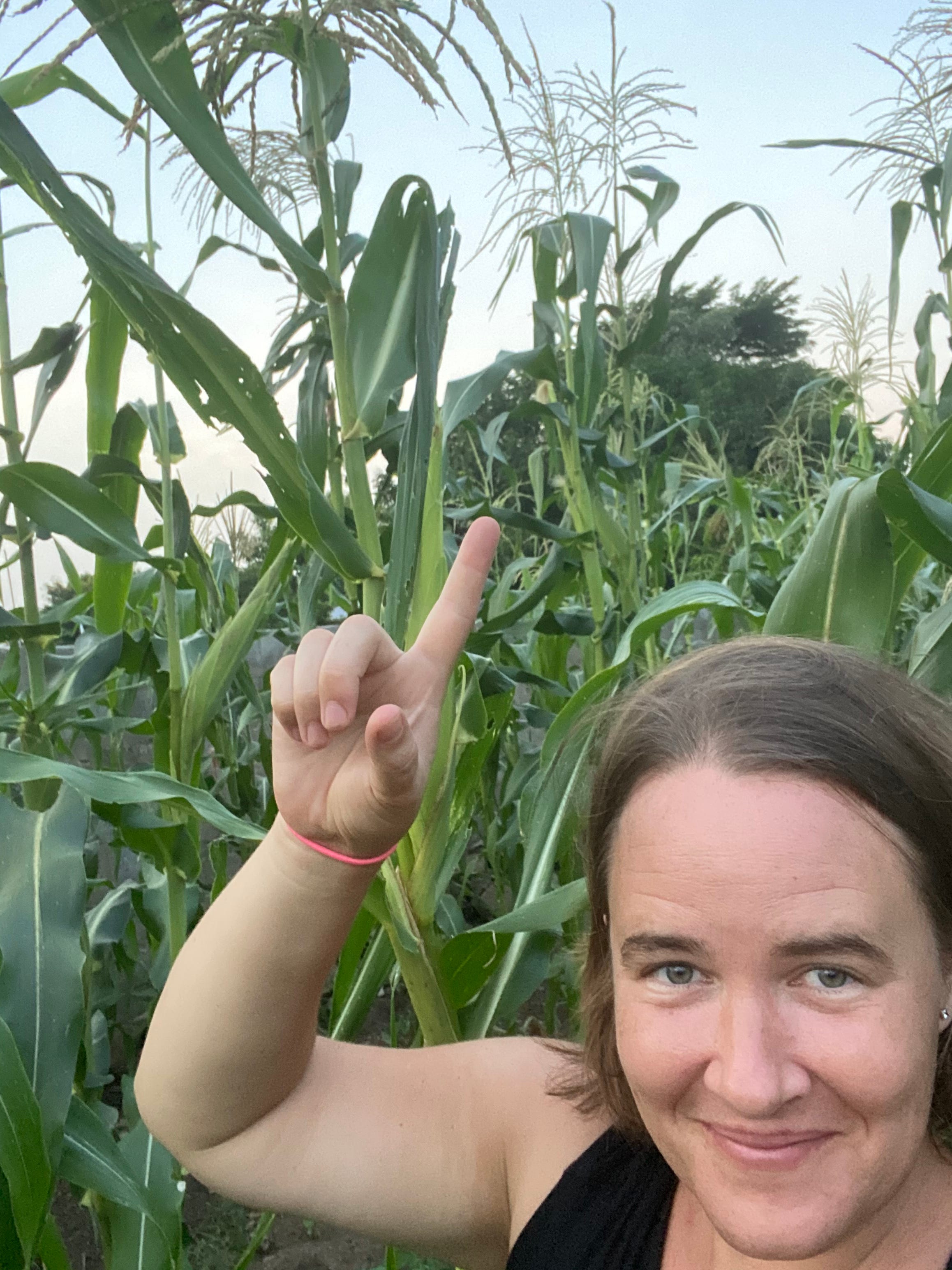
I was in my second year of Peace Corps service in Benin, sitting outside reading The Omnivore’s Dilemma by Michael Pollan. It’s a book about food, specifically about how corn has infiltrated nearly every product we consume in the United States, and how disconnected most Americans are from where their food actually comes from.
I was reading this book, sitting not 100 feet from a cornfield.
The corn had been planted by people in the village of Camate. It would be harvested, ground into flour, and made into la pâte, a staple food that fed families in the community where I was living. I could see it from where I was sitting.
That was a disorienting dilemma. The first phase of Mezirow’s ten phases, the spark, the crack in the lens. In that moment, everything I had assumed about food, about where it comes from, about the gap between American grocery stores and the actual ground, became suddenly, uncomfortably visible.
But the transformation didn’t happen in that moment.
It happened when I came home.
Back in the United States, standing in a supermarket aisle, I started reading labels. I started avoiding processed foods. I sought out farmers’ markets. I made different choices, small ones, consistently, because something had shifted in how I understood the relationship between food and the people who grow it.
The disorienting dilemma happened in Benin. The transformation happened in an American grocery store, months later, quietly, far away from the village cornfields.
That is what transformed frames of reference look like in real life. Subtle. Ordinary. And completely real.
The Baby
A second example comes from my time in Benin, where children are everywhere.
Babies are often carried on their mothers’ backs during funerals, weddings, and important family events, from morning until night. Even in noisy environments, the babies sleep, close and warm and held. Not only that, but they also sleep with their mother. Not in a crib next to the bed, or in a separate bedroom down the hall. Nestled right in next to the food source and her beating heart.
This was a disorienting dilemma for me. I had always believed that babies should sleep in a separate room, in a crib. Observing this practice every day made me question my assumptions and frames of reference, quietly, without drama, just a slow accumulating question I didn’t quite know what to do with.
So I filed it away. Came home. Moved on.
And then in 2014, five years after my Peace Corps service ended, I had my first child.
I tried the crib. I did what I had always assumed you were supposed to do. And neither of us slept.
And then I remembered Benin. I tried something different.
I put my little guy next to me in bed.
He slept. I slept. No need to get out of bed to nurse him back to sleep. Just a little blip in my dreams.
Five years. That’s how long it took for a disorienting dilemma experienced in Benin to complete its journey and arrive as a changed behavior in my real life. That’s not a trip of a lifetime moment. That’s transformation. Quiet, delayed, ordinary, and real.
And that travel professional was right: it didn’t change my life. It changed one small thing about how I lived it. But that small thing? That’s a frame of reference that shifted. That’s transformative learning. Even five years later. Even quietly. Even without anyone calling it that at the time.
The Part Nobody Talks About
Both of those examples have something in common: the transformation happened after. Not during the experience. After.
Mezirow’s research is clear on this. The later phases of transformative learning, the ones that determine whether a shift actually lasts, happen when you return to your regular life and try to integrate what you encountered. That family in Ecuador came home with their horizons shifted. What happens next? Do those shifted horizons show up in how they make decisions, how they talk to their kids, and what they prioritize? Or do they slowly fade back into the comfortable familiar?
That depends on whether the shift is supported.
One of the most important tools throughout the entire process is reflection. Journaling, whether in video, voice, or writing, is one of the most critical elements in this process. So are conversations with others: fellow travelers who shared the experience, people who ask the right questions when you get home, a community you can return to when you encounter a barrier or an assumption you don’t know how to work through on your own. It keeps the disorienting dilemma alive long enough for the transformation to complete itself. It creates the space for the shift to land.
What This Means for Hello West Africa
When I say Hello West Africa is designed around transformative learning theory, this is what I mean.
I am not promising that you will have a life-changing moment while you are in Benin. You might. But that is not the point.
The point is that we are designing for what happens after.
The tour begins two to three months before you even arrive, with activities designed to prepare your frames of reference for what you will encounter. We want you to arrive already curious, already questioning, already open to the disorienting dilemma that Benin will inevitably provide.
And then we stay connected after you leave. Because that is where the subtle magic happens. Not in the moment of eating la pâte for the first time, or hearing a drum circle at night, or walking down to the Port of No Return. In those moments, you are experiencing the disorienting dilemma. The transformation comes later, in the ordinary moments of your regular life, when something you encountered in Benin suddenly makes sense of something you see at home.
We want to be there for that part too.
That travel professional said he can’t change lives, but he can enrich them. I respect that. But I think enrichment and transformation are not as far apart as they seem. When horizons shift forever, even subtly or slowly, frames of reference change.
That’s transformation. And it deserves support all the way through.
One Thing to Sit With
Think about a time when something you experienced while traveling, or during any significant life change, didn’t fully land until much later. Not the moment of the experience. The moment it changed something small in your daily life.
That quiet moment of change? That’s transformation. It was always happening. You just didn’t have a name for it yet.
Hit reply and tell me yours, I’m curious!
Until next Thursday,

P.S. — The Omnivore’s Dilemma is still one of the books I recommend most. If you haven’t read it, add it to your list. Maybe you can read it while you are visiting me in Benin, sitting next to a corn field! The disorienting dilemma hits differently that way.


