


It was 2003. I was 21, sitting in my uncle’s car on the way to JFK, and Norah Jones was playing.
Come away with me in the night…
I was about to board a plane to Namibia, in Southern Africa, for a three-month internship with the Cheetah Conservation Fund. I had fundraised my way there. My dad had helped me buy the ticket from a travel agency, one you actually had to walk into. I didn’t have a cell phone. The internet existed, but just barely.
I remember standing at a payphone inside JFK, calling my parents before I boarded. I was scared and excited and crying all at once, the way you cry when something is both wonderful and terrifying in equal measure. I didn’t know when I would talk to them next.
As it turned out. Once. In three months.
To this day, every time I hear Norah Jones sing that song, I am back at that payphone. Twenty-one years old, about to go somewhere that would quietly begin to change everything.
Where Hello West Africa Really Comes From
I want to tell you something about Hello West Africa that doesn’t appear in the business plan.
The design of this company, the philosophy behind it, the way it’s structured, what it prioritizes and why, didn’t come from a classroom or a textbook. It came from experiences. Specific ones. The kind that leaves a mark so quietly you don’t realize it until years later, when you look back and think: oh. That’s where that started.
It started in Namibia.
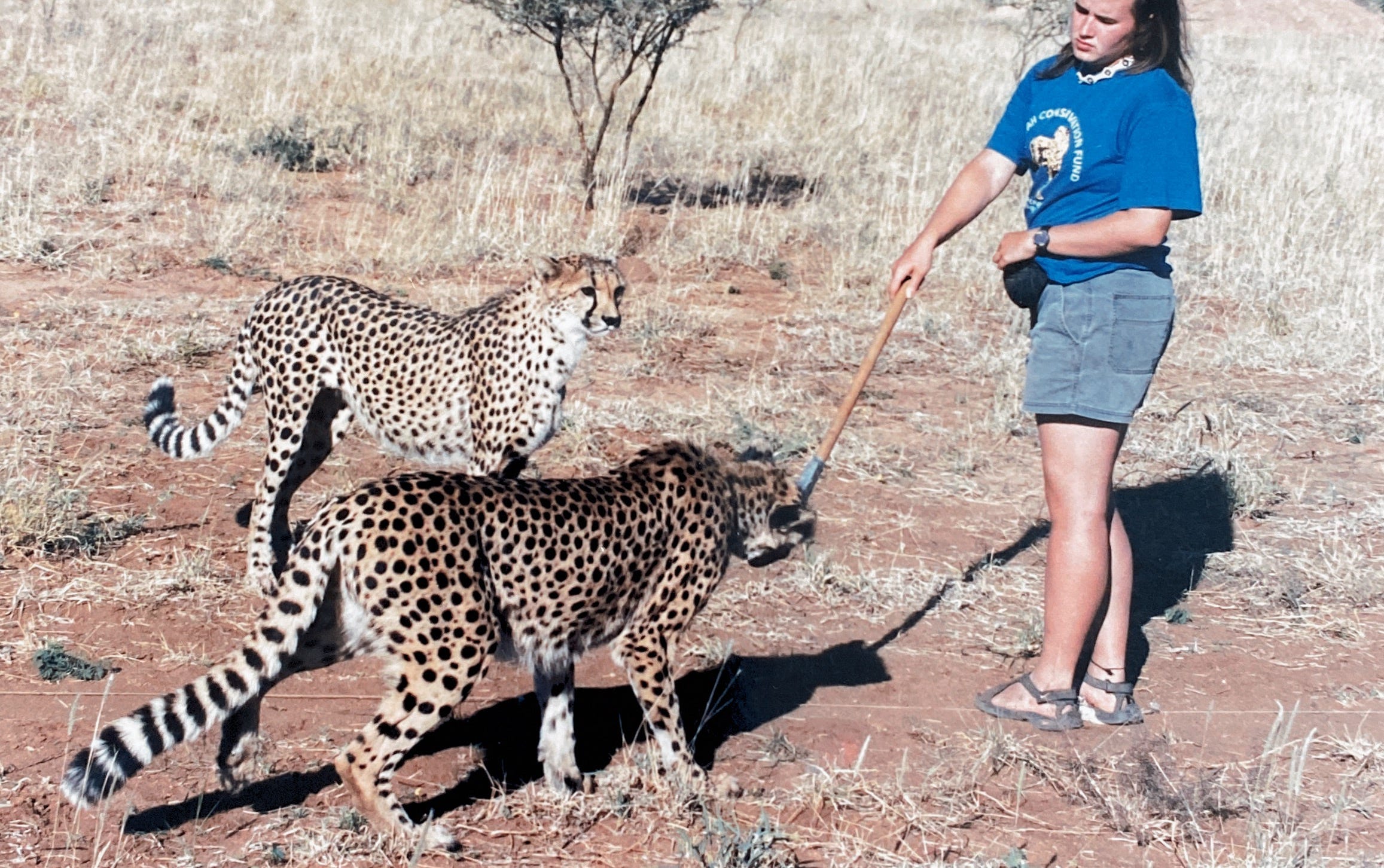
I arrived at the Cheetah Conservation Fund for the first time at night. My job as the passenger was to watch for wildlife crossing the road. At any moment, a giraffe or kudu could have appeared in the headlights. I certainly wasn’t in Kansas anymore, although in Alaska, moose could cross the road. Before going to bed, I looked up and saw the Southern Cross.
The next morning, I saw the place with wide and curious eyes. CCF’s headquarters sits on a 142,000-acre reserve adjacent to the Waterberg Plateau Park in central Namibia, a full-scale research and education facility with thatched-roof buildings that caught the morning light in a way I still remember. It is a remarkable operation, built from the ground up by Dr. Laurie Marker, whose words I only recently rediscovered:
“We always think there is someone else who will do something, that ‘they’ will take care of it. I realized early in my work that there is no ‘they,’ and so I decided that I would take action.”
I had no idea how much that sentence would eventually mean to me.
(There were also giant flat spiders on the bathroom walls. Now that’s something I had to get used to...couldn’t scream and run away every time I saw one!)
I worked with cheetahs. I went for runs after work and got warned to watch out for oryx, baboons, and warthogs on the path. I learned from people who had dedicated their lives to conservation. It was everything I had hoped for.
And yet. There was a nagging feeling I couldn’t quite name.
The Namibian staff who worked at CCF lived with their families nearby, but I was never invited over. I wanted to see what a traditional Namibian home looked like. I was curious about their lives and their culture. (One of the young Namibian interns mentioned missing sour milk once, and I found myself thinking, who would want to drink sour milk?) But there was an invisible line between the visitors’ world and theirs, and I didn’t know how to cross it. I’m not even sure, looking back, whether I could have asked.
I filed it away as a nagging feeling I couldn’t name yet. And I moved on.
Then something else happened that planted a second seed.
Two Peace Corps volunteers had recently transferred to CCF from a village posting elsewhere in Namibia. They had spent their service helping build a library for the community. They had poured time, funding, and effort into it. And then the library sat unused. The volunteers couldn’t understand why no one was coming. They felt like none of their work was appreciated. (I’m sure there were other issues. That was over 20 years ago, and memory is imperfect.)
I was 21. I didn’t say anything out loud. But a question formed quietly in the back of my mind:
Did the community even want a library in the first place?
Fast forward four years. The Peace Corps idea had been circling for a while, surfacing when I was working with cheetahs again in White Oak, Florida, and again when I moved to Seattle and was working at Starbucks. I finally submitted my application. They said: Congratulations, you’re going to Benin!
I had to find Benin on the world map.
I took French lessons. I checked the CIA World Factbook. I learned that Benin had two national parks in the north with safari-style wildlife. I thought, given my background, they would surely post me there.
Instead, I was assigned to a small village called Camate-Shakaloke, to work with an organization called CPN les Papillons, Connaître et Protéger la Nature “les Papillons.” Papillon means butterfly in French. I thought maybe I would be working with butterflies.
It was actually a small tourism and education nonprofit, a modest inn and restaurant, eco-tours through the village and up into the hills, and facilities for community meetings. My future husband, Thomas D’Aquin Kouda, had helped form it. The wildlife I encountered was chickens, goats, cows, and the occasional snake. Monkeys, rarely.
And I didn’t miss the exotic animals. Not once.
Because Africa, the real Africa, the one that doesn’t make it onto safari brochures, became about something else entirely. The people. The culture. The way communities hold each other. The extraordinary ordinary life of a place the rest of the world had decided wasn’t worth looking at carefully.
I remember one evening, sitting outside D’Aquin’s family photography studio alongside the main road going north, sharing a glass of sodabi (the local distilled palm wine, something like moonshine) with D’Aquin, his father, and a few other men. The conversation had drifted to money, specifically to the various aid organizations that came through, bringing funding, plans, and decisions made somewhere far away by people who had never lived there. One man looked up and said:
“I wish they would just give us the money. We know what to do with it. We don’t need anyone telling us what to do with it.”
I still think about that conversation.
That nagging feeling from Namibia? It finally had a name.
I didn’t want to observe from a comfortable distance. I wanted to belong, even briefly, to somewhere real.
That instinct, don’t impose, be invited. Observe, understand, then belong is the entire philosophy of Hello West Africa. It didn’t come from my dissertation. It didn’t come from a business book. It came from a payphone at JFK, a Namibian staff member who missed sour milk, a library nobody asked for, a glass of sodabi on a dirt road, and a small tourism and education nonprofit with a butterfly in their name in a village I hadn’t planned to go to.
Every experience shaped the design.
And Dr. Laurie Marker? The woman who decided there was no “they” and just did it herself?
I think about her too.
What Really Happened Last Week
I had a list. It was ambitious. Here is what the list said and what actually happened:
Finish the final version of the business plan draft — done. ✅
Sending it to my SCORE advisor this week. (And since we’re building in public, I used LivePlan to put the financials together, and it is incredible. Especially for someone who loves watching other people build beautiful Excel sheets but is considerably less confident building them herself.)
Redo the website — started.
Nowhere near finished. The website is currently somewhere between “old version” and “new vision,” which is its own special kind of chaos.
LinkedIn posts — done. ✅
Instagram — done. ✅
I have started working with an Instagram coach, which is already incredibly helpful. Social media is a landscape I have observed for a long time without fully participating in. Having someone to ask questions is making a real difference.
Start the pitch deck — did not happen.
It is on this week’s list.
Actually call anyone about investment — also did not happen.
This is the one that requires me to go through it rather than around it. Working up to it. Publicly. Right here.
So. Partial credit. Moving on.
What I’m Learning
Two things this week.
The first: building in public is not a social media invention. Walt Disney set up a time-lapse camera while building Disneyland in the 1950s and shared the footage with people. He wanted them to watch something being created in real time. He also said something I keep coming back to:
“The park means a lot to me in that, it’s something that will never be finished. Something that I can keep developing. A thing I can keep building as long as I can get some money to build it with.”
That’s exactly what Hello West Africa is. The impulse to bring people along, to make the building itself part of the story, is not new. It’s human. I find that genuinely comforting.
The second: I always overestimate what I can accomplish in a week, usually because I forget that I am also the CEO of my family. (The title comes with no salary and considerable responsibility.) I’m working on time blocking by starting with tracking where my time actually goes, using the Toggl app. It is both illuminating and occasionally disconcerting. Laura Vanderkam would approve.
I also have a bulletin board now, inspired by someone on Instagram, where I can see everything and physically move things around. Visual, tangible, real. Much better than a list I can’t see.
What’s Coming Next
This week, the pitch deck gets started; no more avoiding it. The website continues. And I am going to make at least one phone call about an investment. Actually asking the question to give money. One. That’s the goal. One name, one conversation.
I have been thinking about setting up a time-lapse of my own, of the website being built, or the pitch deck taking shape. Mostly, I stare at a screen, which is less cinematic than Disney’s construction crew. But the spirit is the same.
I also plan to start sharing some of the tools and apps that are making this build easier. I love finding things that work, even if that means occasionally going down a rabbit hole for hours. (Nerdy, I know, but also so much fun. And most of the time, worth it. Usually.)
I can’t wait for the day I get to tell you the capital has been raised and we are heading back to Benin. When that happens, I’ll start sharing what’s happening on the ground at Kabole, the construction updates, the property, and the community. That’s the part of this story I can’t wait for you to see.
In My Free Time
It rained all week here in Washington. And then on Friday, it flooded. The second time this winter, the first being December. The gray is something I haven’t quite made peace with, but I appreciate the moments when the sun appears. We got out for a couple of walks. We made homemade pizza, dough and all.
The episode of The Pitt was something else. No spoilers.
On the reading list this week:
The 48 Laws of Power by Robert Greene
Queen Charlotte by Julia Quinn
Tales from Another Mother Runner, edited by Dimity McDowell and Sarah Bowen Shea, because I am attempting to get back into running, and reading stories of other mothers running sparks the joy in running that I know is there.
And the daily crossword. Always the daily crossword.
The boys are well. Life between here and Benin continues, even when Benin feels far away.
Until next Tuesday,
P.S. — The library nobody asked for. I think about that more than you might expect. It’s in the DNA of everything we’re building.


